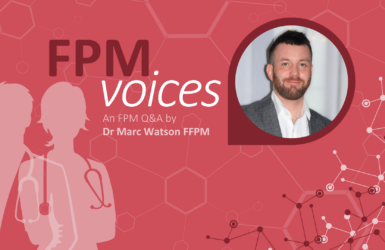
Dr Marcia Philbin
An FPM Voices Q&A
Posted on: Wednesday 29 October 2025
Author: Dr Marcia Philbin
This Q&A has been prepared by Dr Marcia Philbin in celebration of Black History Month.
Dr Marcia Philbin is the Chief Executive of FPM, a position she’s held since 2019. She spent the first half of her career working as a research scientist for the Ministry of Defence before moving into the world of Royal Medical Colleges. Marcia spearheads the work of FPM to educate and train physicians who are involved in the development, approval and regulation of new medicines. Marcia is a Fellow of the Royal Society of Chemistry and the Association of Project Management. In 2024, she was recognised by Management Today on their Women in Leadership Power List.


FPM Voices is a Q&A interview series that shines a spotlight on the careers and insights of senior and influential pharmaceutical physicians. Through these conversations, we aim to provide colleagues with a deeper understanding of the opportunities, challenges, and rewards of pharmaceutical medicine.
Each interview explores personal career journeys, key lessons learned, and the role that the Faculty of Pharmaceutical Medicine (FPM) has played in shaping professional growth.
What first sparked your interest in pharmaceutical medicine, and what has kept you passionate about the field?
My interest was sparked before I knew what pharmaceutical medicine was! Early in my career, I undertook research into energetic materials (explosives and rocket propellants) using a new nitrating agent which was more environmentally friendly than the traditional ones. I applied this technology to the development of specialty chemicals and one of them was an intermediate used in neveraprine, the anti-AIDS drug which prevents the virus being passed from pregnant women to the unborn child. I engaged with a number of pharmaceutical companies to discuss how I could help them reduce the costs of their products including taking a trip to Germany to see a large pharma company.
What does FPM represent to you, both professionally and personally?
FPM represents the values which are important to me such as professionalism, integrity, and optimism which have helped me to strive to be the best that I can be despite challenges I have faced during my life.
In what ways have you helped champion FPM’s mission for the next generation of pharmaceutical physicians?
It has been important for me to be visible to help raise the profile and mission of FPM. For example, I am a Fellow of the Royal Society of Chemistry (RSC) and won funding from them to undertake the Women in Pharmaceutical Medicine project. The results of the project were shared for two years at the RSC Inclusion Conference. I have been invited to speak at many events in my capacity as Chief Executive and have used those platforms to introduce and educate, as many do not know about the specialty of pharmaceutical medicine.
What’s a recent innovation or lesson – whether from colleagues, patients, or scientific advancements – that has inspired or changed your perspective?
The innovations which arose from the COVID-19 pandemic shows what can be achieved when there is a unifying goal, focus, energy, tenacity and collective sense of accomplishment for the global community.
Throughout your career, what has been your greatest challenge, and how do you stay resilient in the face of setbacks?
One of the great challenges was maintaining my career after having my twin boys. I was fortunate that the Ministry of Defence was ahead of the curve and allowed me to return to work for three days a week and to lead a national project within the Soldier Modernisation programme. Having the genuine sponsorship of my employer to maintain my career was essential and appreciated.
And finally, if you had to describe your job using only a movie title, what would it be?
Star Trek: The Undiscovered Country
More from this series