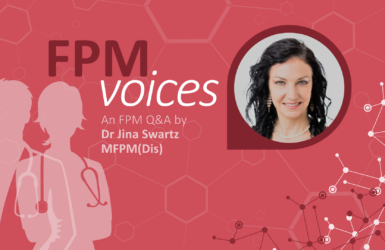
Dr Jina Swartz MFPM(Dis)
An FPM Voices Q&A
Posted on: Wednesday 4 March 2026
Author: Dr Jina Swartz
This Q&A has been prepared by Dr Jina Swartz MFPM(Dis) FMedSci in celebration of International Women's Day 2026 (8 March).
Dr Jina Swartz MFPM(Dis) FMedSci is an accomplished physician and researcher who holds degrees in Internal Medicine and Neurology obtained in South Africa, as well as a PhD from the University of Cambridge. In 2020, she was elected to Fellowship of the Academy of Medical Sciences for her global expertise in neurodegenerative disorders and neuropsychiatric drug development. In January 2025, she was elected as a Member Trustee of FPM.

FPM Voices is a Q&A interview series that shines a spotlight on the careers and insights of senior and influential pharmaceutical physicians. Through these conversations, we aim to provide colleagues with a deeper understanding of the opportunities, challenges, and rewards of pharmaceutical medicine.
Each interview explores personal career journeys, key lessons learned, and the role that the Faculty of Pharmaceutical Medicine (FPM) has played in shaping professional growth.
What first sparked your interest in pharmaceutical medicine, and what has kept you passionate about the field?
As a Neurologist and Neuroscientist, I first embarked on a career in molecular research because I strongly believed (and still hold this belief) that the solutions to effectively treating neuropsychiatric disorders lie in us better understanding disease pathogenesis on a sub-cellular level – whether in molecular or genetically-mediated pathways. When looking at other disease areas where significant advances have been made on a therapeutic development basis, like oncology or immunology, I felt that similar progress could and should be made in the Neuroscience space – and I very much wanted to be a part of that journey. This conviction led me to completing my PhD at Cambridge in the molecular neurogenetics of Huntington’s disease and propelled me down the path of developing therapies for neurodegenerative disorders – an area of focus that I have maintained with passion and conviction ever since.
What does FPM represent to you, both professionally and personally?
FPM represents to me a professional institution that encompasses the diversity of researchers and clinicians involved in developing effective pharmacological and non-pharmacological interventions for treating disease. On a personal basis, it is a body that provides a supportive and nurturing environment for medical professionals involved in the development of therapeutic options. It allows specialists, like myself, and non-specialists to collectively embrace and counter the unique challenges that working in the pharmaceutical industry embodies.
As an elected Fellow of the Academy of Medical Sciences, I am frequently struck by the lack of understanding of my academic colleagues at the Academy, of the work and focus of those physicians working in the pharmaceutical industry. An organisation like FPM goes a long way to facilitating better understanding and awareness of the diversity of skills pharmaceutical physicians possess, as well as providing a ‘safe home’ for those of us working in this multi-faceted arena.
In what ways have you helped champion FPM’s mission for the next generation of pharmaceutical physicians?
Having joined the Board of Trustees of FPM in the last year, I have enjoyed working alongside other Board members to revitalise and reinvigorate the focus of FPM, as it strives to support pharmaceutical physicians in the UK and beyond. It has been an interesting and educative process working as a Trustee, also allowing me to draw on the experiences I have enjoyed as a Trustee of several other charities external to FPM.
What’s a recent innovation or lesson – whether from colleagues, patients, or scientific advancements – that has inspired or changed your perspective?
The recent development of gene-based therapies (as challenging and targeted as they are) have served to reinforce my early conviction about our ability to link effective therapies to underlying genetically-mediated mechanisms. As our understanding in this area grows, my hope is that more accessible and affordable therapies will be developed, serving patients with both common and rare, monogenic and polygenic disorders, alike.
How would you describe what you do to people who haven’t heard of pharmaceutical medicine?
I conduct research into neuropsychiatric disorders, with particular emphasis on both common and rare neurodegenerative disorders like Alzheimer’s disease and related dementias, movement disorders like Parkinson’s and Huntington’s disease, neurological disorders like acute ischaemic stroke and epilepsy, neuroimmune based conditions including multiple sclerosis and psychiatric diseases like schizophrenia, major depression and anxiety. In so doing, I design the strategies and protocols for global clinical trials in these therapeutic areas, ensuring that the studies are conducted in scientifically rigorous manners, to generate reliable data that will allow for ultimate drug approval and registration. Much of my work has also been in the Translational Medicine space, where I design earlier studies that effectively bridge the gap between preclinical (and animal-focused work) and the human patient, using novel fluid-based, imaging or interventional strategies.
What is one of the biggest misconceptions about pharmaceutical medicine, and how do you think we can change that perception?
On of the biggest misperceptions about pharmaceutical medicine, as evidenced by responses from both Academy and clinical (NHS-based) colleagues is that the focus is a purely commercially-driven one. There is a lack of understanding of the scientifically robust work that pharmaceutical medicine practitioners perform and limited awareness of the highly regulated environment in which we operate. This can only be overcome by our continued practice of globally-renowned research of the highest quality, conducted to exacting ethical and compliant standards, as we develop medications and novel therapeutic innovations to enhance the quality of life of the patients we serve.
And finally, if you weren’t a doctor, what completely different career would you want to try?
Dancer and choreographer. As an ex-professional dancer, I have continued to use dance and movement therapy as both diagnostic and therapeutic tools in my clinical and research practice. I regularly conduct dance workshops for people with dementia, learning disabilities, elderly and frail patients, as well as the unimpaired.
More from this series