
As part of the FPM Strategy for 2026-28 (notably the pillars of; Promoting a Shared Professional Identity, Extending Reach and Increasing Influence, and Nurturing Ideation and Innovation), we have developed five key policy areas for FPM to focus on in 2026. Whilst there will be space for reactive policy work, these five key themes will strategically focus FPM’s policy outputs.
To scope and devise the policy themes for FPM to address in 2026, we undertook a wide and deep phase of internal engagement.
The Five Policy Themes
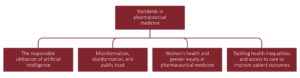
Standards in pharmaceutical medicine
The overarching policy theme, of which the other policy themes will fall under, will be promoting and ensuring high standards for doctors working in pharmaceutical medicine.
The current safety issue is that there are no requirements for doctors working in pharmaceutical medicine – including those involved in the development of innovative technologies and artificial intelligence (AI) tools – to hold medical registration with the UK General Medical Council (or an equivalent body in their jurisdiction), belong to a recognised professional standards-setting body such as FPM, or demonstrate that their specialist knowledge remains current and subject to appropriate external scrutiny.
Currently, doctors from any speciality can move to work in the design and development of medicines, innovative technologies, and AI tools. In clinical practice, it would be inappropriate for a doctor in gynaecology (for example) to then work in pathology without the appropriate specialty training. So why is it that any doctor can then work in the speciality of pharmaceutical medicine?
FPM proposes, as an overarching policy ambition, that doctors working in pharmaceutical medicine need to adhere to adequate standards. FPM must be the home for doctors working in all aspects of pharmaceutical medicine. Pharmaceutical medicine must be both recognised and treated as a medical speciality with parity with, for example, surgery or pathology. The development of medicines, innovative technologies and AI tools that impact patient care should be undertaken by appropriately trained experts operating within clear professional standards to ensure patient safety.
The responsible utilisation of artificial intelligence
AI is widely used across pharmaceutical medicine development and delivery. There is an inevitability (and exciting opportunity) that its application and usage will become more widespread and prevalent.
AI is a transformative tool across pharmaceutical medicine, including in drug discovery, clinical trials, medical affairs, HTAs, pharmacovigilance, diagnostics, medical writing, education, and in the delivery of safe patient care.
Whilst these applications may change the way pharmaceutical medicine is conducted and delivered, there are clear risks involved. These include the need for human oversight and continued monitoring for validity, ethical considerations, data privacy, regulatory considerations, transparency of data used, bias in data, misinformation, and trust in AI-generated content.
FPM has a role in developing clear policy and guidance for pharmaceutical physicians on the use of AI.
Misinformation, disinformation, and public trust
Whilst social media content and AI tools are a major and valuable source of health information for millions of people, it is vitally important that any information and advice which could impact on an individual’s health is accurate. As highlighted through the COVID-19 pandemic, there was a growing populist distrust in ‘expertise’, this scepticism created a vacuum which misinformation and disinformation sought to fill.
Tackling health misinformation and disinformation is something physicians across all specialities need to do. Creating clear guidance and providing support for physicians will help them in their roles and in turn improve public trust in medicines. This will have clear health benefits for patients.
Women’s health and gender equity in pharmaceutical medicine
Pharmaceutical medicine plays an important role in ensuring the health of women is served. To adequately deliver healthcare that is safe and appropriate, women must be included in the design and development phases of new medicines (through the clinical trial process), new health technologies, medical devices, and any diagnostic tools.
We have seen first-hand the dangers of inadequate diversity in the development of new technologies and medicines for women and for their unborn children.
Tackling health inequalities and access to care to improve patient outcomes
There are significant health disparities globally and across the UK itself. Those living in deprived areas face worse health outcomes than those living in affluent areas. These inequalities are prevalent within pharmaceutical medicine, whether that be access to clinical trials, the limited involvement of low and middle-income countries in clinical trials, the diagnosis phase, use of digital technologies, and the risks of reinforcing existing biases.
There are other external factors to consider, too. Including the rising costs of medicines, pressures on health systems, and the postcode lottery of care.
Tackling inequality and access to care will of course improve patient outcomes for those who need it the most.