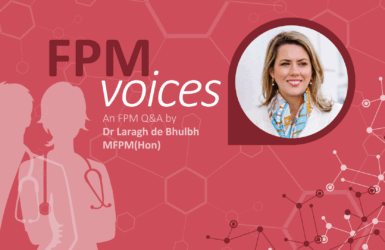
Dr Laragh de Bhulbh MFPM(Hon)
An FPM Voices Q&A
Posted on: Wednesday 27 August 2025
Author: Dr Laragh de Bhulbh MFPM(Hon)
This Q&A has been prepared by Dr Laragh de Bhulbh MFPM(Hon).
Laragh is the founder and Managing Director of Wolf Medical Ltd and she has a particular interest in Medical Affairs Strategy and supporting those in Medical Affairs become strong cross-functional leaders. Laragh is also on the Faculty at King's College London where she lectures on Medical Affairs strategy. She became an Honorary Member of FPM in 2025.


FPM Voices is a Q&A interview series that shines a spotlight on the careers and insights of senior and influential pharmaceutical physicians. Through these conversations, we aim to provide colleagues with a deeper understanding of the opportunities, challenges, and rewards of pharmaceutical medicine.
Each interview explores personal career journeys, key lessons learned, and the role that the Faculty of Pharmaceutical Medicine (FPM) has played in shaping professional growth.
What first sparked your interest in pharmaceutical medicine, and what has kept you passionate about the field?
At 15 I went to an open day at University College Dublin and sat in a lecture on pharmacology. From that moment I was hooked. I’ve always been fascinated in how medicines work and the incredible benefits they can confer to patients. That strengthened when I moved into medical affairs and saw the transformative impact of medicines on patients’ lives. During my Masters in pharmaceutical medicine, I was fascinated about the complexities and ethics around access to medicines. Every lesson we learned on the importance of clinical trials, ethics, and compliance spurs me on to do better and encourage others to do the same. As the field evolves, my passion is helping those who work in pharmaceutical medicine to create a bigger impact for patients and the field by helping them understand and maximise their leadership, communication and strategic thinking skills.
The field itself is constantly evolving and therefore the skillset that is needed needs to evolve, so those in the field have a stronger voice for patients. It is important to be able to stand up confidently and advocate for what is right.
What does FPM represent to you, both professionally and personally?
FPM upholds rigorous standards and provides a structure to champion ethical development and innovation in the pharmaceutical industry. Personally, it is an honour to have been accepted, especially as a non-medic. FPM provides a forum for discussion and further development, meaning that high standards will continue to be upheld within the area.
In what ways have you helped champion FPM’s mission for the next generation of pharmaceutical physicians?
From my experience in pharma, having a strategic mindset is critical to really delivering improvements in patients’ lives. While pharmaceutical physicians, pharmacists and scientists who transition into medical affairs or pharmaceutical medicine have incredible skillsets, this is an area that is underdeveloped. By driving education and highlighting the importance of strategic thinking at all levels, we can increase the impact of pharmaceutical physicians on patients’ lives. This in particular is a message I champion. I identified this as a core skills gap in the area and succeeded in having the topic included on the MSc/Dip Pharm Med course in Trinity College Dublin. Since being appointed to the faculty in Kings College London, I have been involved in both the delivery of education on strategy on the Masters in Medical Affairs course, as well as contributing to the upcoming textbook on the same topic. Through my own consultancy I have developed the first CPD accredited Mastering Strategy for Medical Affairs certificate course. As part of this, I emphasise the importance of taking a compliant approach in all activities, as to ignore this devalues any contributions we make to improve patient care.
The second part is to ensure those working in the field are heard, and that their impact is clearly communicated. While the impact is there, it is often unclear to many in the field how to capture this. I’m passionate about helping those in the field of pharmaceutical medicine find their voice and communicate clearly, so that the impact they bring for patients goes further.
What’s a recent innovation or lesson – whether from colleagues, patients, or scientific advancements – that has inspired or changed your perspective?
Hearing the citations of the recent Honorary Fellows and President’s Medal at the FPM Annual Awards Ceremony to me highlighted the importance and advancements of research in the area. I think resilience is key – if something doesn’t work but you really believe in it, consider how else it can be achieved. Often we get stuck in details, but we need to be able to carve out time to take a step back to get clarity and a fresh perspective. This allows new developments in medicines and how they reach patients.
Another perspective that I heard from a patient advocate at a conference was the importance of remembering that there is no one “patient-journey”. Rather, all patients have individual journeys. This is something we need to keep in mind in order to provide the best standards of care for patients.
Throughout your career, what has been your greatest challenge, and how do you stay resilient in the face of setbacks?
Learning that you don’t have to have all the answers before you move ahead. It’s okay to make mistakes and learn from those mistakes. I’ve delayed making decisions without the full information and in pharma it moves at a much faster pace. Often we need to make decisions with less information in a more timely manner. If you make a mistake, ask yourself what the learnings are from it. You will always find ways to grow if you take this approach.
What is one key change or advancement you hope to see in pharmaceutical medicine in the coming years, and why?
The importance of strategic thinking as a core skill. It is a very necessary skill at all levels of pharmaceutical medicine and its importance is only becoming realised now. It’s not something that is taught to physicians, pharmacists or scientists during their training. The fact it is now included as part of the Masters of Medical Affairs at King’s College London is a big advancement. In order to make better decisions, to focus on the right areas, and to create real impact you need to think strategically.
If you were a superhero, what would your superpower be?
Clarity – I help people break down ideas and the challenges they face so that they become clear on what they want to communicate, how they are going to communicate it, and why they are going to communicate it. This allows people to go and have greater impact. I do this through a combination of training, mentoring and coaching. Everyone has different needs and it is important to tailor the approach to the individual.
More from this series