My Unexpected Road to Pharmaceutical Medicine
Posted on: Thursday 15 October 2026
From medical oncology and academia to biotechnology and pharmaceutical medicine, Dr Michael’s career has taken a few unexpected turns. Having recently completed Pharmaceutical Medicine Specialty Training (PMST) and achieved his Certificate of Completion of Training (CCT), he reflects on his unconventional journey into the specialty, the value of PMST in shaping his career, and how he has found a way to combine his passions for clinical medicine, research and drug development.
I came to pharmaceutical medicine by what might generously be called the scenic route. Less generously, I spent several years attempting to spin multiple professional plates at once and hoping nobody noticed the wobbling.
Only now are those strands — clinical medicine, academia and industry — beginning to feel like one interwoven career. Better still, each part genuinely strengthens the others, which feels particularly important when you consider the scale of the challenges facing medicine, be this cancer, dementia or global health inequalities.
That all sounds reassuringly deliberate. It was not.
A masterplan (what could possibly go wrong?)
At medical school, it became clear that I sat firmly towards the nerdier end of the spectrum. I loved the deeper scientific parts of the course and spent almost every summer doing some form of laboratory studentship. My friends were understandably confused as to why I kept cutting short opportunities to travel so I could return to a lab. Some of the samples I used in oncology and immunology projects came from clinical trials, giving me an early glimpse of how laboratory science could connect directly with patient care. I loved the idea of going beyond what was already known and having to think creatively on how to interpret an unexpected result from a novel assay.
Medical oncology seemed the natural destination. That interest came from a mixture of personal experience and fascination with the underlying biology. Cancer is evolution running without a speed limit: exploiting the body’s own systems, interacting with our genes and environment, and creating extraordinary scientific and clinical complexity. During my intercalated degree, I completed a 12-month research project using samples from a glioblastoma study to explore novel pathways of angiogenesis. Here I received some inspiring mentorship and, as a result, firmly geared myself towards an academic career.
I set about mapping out the next 15 years with the delusional confidence that only your early twenties can provide. The route was clear: publications, teaching, audits, quality-improvement projects and anything else that might provide another tick in a box.
I was therefore over the moon to secure my first-choice Academic Foundation Programme post in London, the first major postgraduate milestone in my clinical academic masterplan. With a medical oncology theme and mentorship from Professor Tom Powles at Barts, I loved every minute of the clinical work, involvement in trials, and getting to work with the university on translational projects. After foundation training, I stayed for another two years as a clinical research fellow and began applying for PhDs that, according to the plan, would then progress to academic clinical fellowships, lectureships, CCT, early-career researcher grants, professorship, retirement, and a contented death from natural causes surrounded by Nature publications. It was all onwards, upwards and, ideally, towards another PubMed ID.
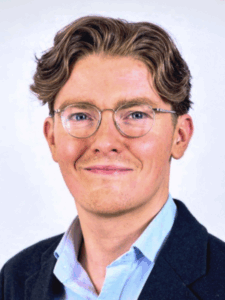
Read Michael’s biography
Dr Michael Grant is a pharmaceutical physician and physician-scientist specialising in the clinical development of novel oncology treatments for solid tumours.
He is currently Vice President, Clinical Development at Weatherden, where he works as a fully embedded Medical Lead across multiple early-stage biotech and biopharma clients. His work spans clinical development, translational science, and biomarker and commercial strategy.
Michael has held senior medical roles in oncology biotech, where he has overseen clinical development from preclinical data and first-in-human studies through to marketing authorisation – including working on assets that have gained FDA Breakthrough and MHRA Innovative Licensing and Access Pathway designation. Working with a number of CRUK-backed academic spin-outs, he has led international studies of antibody-drug conjugates, cellular therapies, cancer vaccines, and other advanced therapeutic investigational medicinal products.
Alongside his industry work, Michael continues to practice clinically in NHS medical oncology services in London and has worked as an investigator on a wide range of academic and commercial cancer trials. He holds a BSc in Molecular Oncology, MRCP(UK), the DPM, and an MSc in Experimental and Translational Therapeutics from the Department of Oncology at the University of Oxford.
The unexpected phone call
Then, while in the final rounds of PhD applications, I received an unexpected phone call. A biotech company was spinning out of the Crick and wanted a junior, academically inclined physician to work with its Chief Medical Officer on the clinical development of an advanced cellular therapy for solid tumours.
I went to my professor and asked, with great sophistication, “What exactly is clinical development?”. “That’s what you’re doing here,” he said. This was genuinely news to me.
Bolstered by the surprise discovery of relevant experience and after seeking advice from several generous people in medical oncology, I decided to take the job — with the caveat that I could continue some clinical oncology work. My contingency plan was simple: if I hated industry, I would return after six months to the academic pathway and never mention this brief fugue state ever again.
Instead, I loved it.
For the first time, I could immerse myself fully in the research and development process. The biotech was deeply science-led, bringing together major figures from cancer research and academia with highly experienced pharmaceutical-industry colleagues. It was an exciting environment in which to learn, and after about 18 months I had to admit that this was no longer looking like a temporary detour.
A pharmaceutical physician? Who knew?
Around that time, I attended a Lancet theme launch through a committee role. I struck up a conversation with the person unlucky enough to be sat beside me and lamented my various career woes: I had been going to become a medical oncologist, this biotechnology job had appeared from nowhere, I was enjoying it far more than expected, but felt that industry careers remained completely opaque.
My neighbour turned out to be Professor Higginbottom, a former President of FPM. He listened and said, in effect, “It sounds as though you might be a pharmaceutical physician.”
This was awkward, because I had virtually no idea what pharmaceutical medicine was.
In retrospect, the clues were hardly subtle. When I later revisited the results of specialty aptitude tests I had completed during medical school and foundation training, pharmaceutical medicine had repeatedly appeared in my top three choices, alongside clinical pharmacology and medical oncology. The specialty had apparently been trying to get my attention for years whilst I didn’t look up from my long-term plan.
Professor Higginbottom was extraordinarily generous. Although we had met entirely by chance, he arranged time to talk afterwards and introduced me to Professor Peter Stonier. Together, they helped demystify the specialty: what it was, what it was not, how it compared with medical oncology training, and how it could accommodate ongoing clinical and academic work. They also signposted me to current trainees to get a perspective, notably Dr Urmi Shukla who was (and still is) a wellspring of solid advice.
From Googling to gaining a specialty
I subsequently applied for Affiliate FPM membership and PMST, and was delighted to secure a training number.
Until then, much of my learning in drug development had been autodidactic (i.e. googling between meetings) and undertaken at speed; working in a role that came across everything from preclinical and translational science to clinical development. PMST gave that experience structure. It provided a curriculum, a clearer understanding of the breadth of pharmaceutical medicine and, crucially, an external educational supervisor with whom I could discuss ideas and concerns. That support probably did more than anything else to overcome my fairly robust case of imposter syndrome.
The Diploma in Pharmaceutical Medicine (DPM) was also among the most relevant learning I have undertaken for my day-to-day work. MRCP undoubtedly made me a better physician and my Masters in Experimental Therapeutics reinforced the scientific underpinnings of clinical trials, but the DPM curriculum transformed how I understood drug development. It really highlighted how numerous functions come together to turn a molecule into a medicine. Understanding those different perspectives, constraints and motivations has made me a better medical and drug-development lead. It has helped me see how development programmes can be strengthened, where risks can be anticipated, and why colleagues may approach the same problem from very different angles.
Three worlds, one career
Having since worked across several biotechnology companies and, more recently, large pharma, I have now found a particularly rewarding niche at Weatherden. My role supports my clinical, academic and industry identities, allowing me to weave them together in a way that feels genuinely synergistic in supporting private and public cancer drug development – rather than just providing an elaborate scheduling challenge.
I have now CCT’d and become an educational supervisor, with my first drug-development Fellow due to start shortly. I am enormously excited to pass on some of what PMST gave me and, hopefully, to make this career path a little less opaque for those coming behind me.
The road less travelled
If you had told me ten years ago that I would depart from my rigidly delineated oncology plan in favour of a hitherto uncharted academic-clinical-industry portfolio career, I would have thought you were mad. Yet this road less travelled has allowed me – with a lot of support from those directly and indirectly involved with the FPM – to craft a bespoke career that captures everything I find most compelling in clinical medicine, science and research.
So Michael, what does completing PMST mean to you?
Could PMST be your next step?
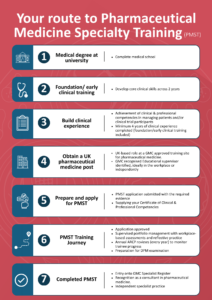 Read our simple steps on how you can get into Pharmaceutical Medicine Specialty Training.