
Who Reviews Your ARCP? A Look Behind the Scenes
Posted on: Monday 30 March 2026
Author: Dr Mireille Cantarini FFPM
If you have participated in Specialty Training in pharmaceutical medicine, or indeed any other medical speciality, you will have taken part in some form of annual review meetings, now known as Annual Review of Competence Progression (ARCPs) – but have you ever wondered about the background of the people performing the appraisals?
In this article, I describe my own route to becoming an ARCP panellist and explain why I would recommend the role to others who have a strong interest in supporting junior colleagues entering pharmaceutical medicine.
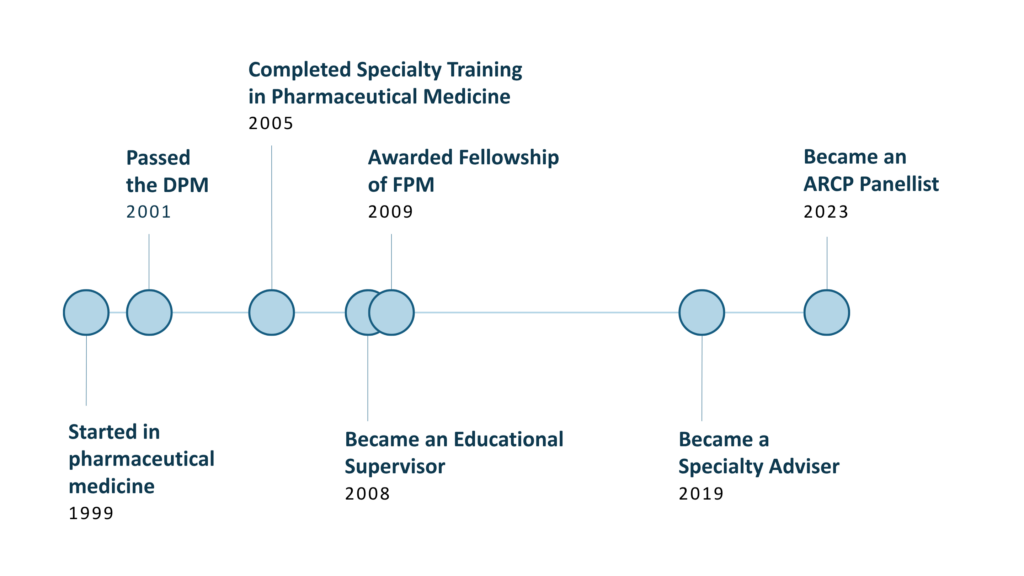
My journey into pharmaceutical medicine started with a biology degree, followed by two years in cancer research before I went on to read medicine. I joined the industry in 1999 when I was offered the opportunity to combine both research and medicine together. After passing the Diploma in Pharmaceutical Medicine (DPM) in 2001, I became an Associate member of FPM. In 2005, I completed PMST (then called Higher Medical Training) and entered onto the GMC Specialty Register in Pharmaceutical Medicine. Alongside my clinical and industry roles, I also became an Educational Supervisor (ES) in 2008 and a Member of the Board of Examiners in 2009. I was awarded Fellowship of FPM in 2009.
In 2019, I applied for the role of Specialty Adviser (SA) which I then went on to perform for several years. Following a career break due to illness, I returned to work in 2023, this time taking on the role of an ARCP panel member.

What do ARCP panel members do?
The role of an ARCP panellist begins well before the formal ARCP meeting. Panel members review the e-portfolios submitted by trainees in advance and assess the evidence provided by both the trainee and their ES against the requirements for that particular year of training. The panel then meet to discuss each trainee’s progress before holding a virtual meeting with the trainees themselves. In most cases, ESs should also attend these meetings to provide feedback which may include:
- Advice on how to improve their portfolio of evidence – gaps, organisation, cross-linking evidence
- Advice on how to improve reflective commentaries (which are the most critical part of a portfolio in my opinion)
- Discussing the focus for next year’s training, especially the importance of completing the Diploma in Pharmaceutical Medicine
- Providing the panel’s assessment of the outcome for the previous year’s training
- Discussing if the trainee needs to take more time to complete training which could be time out of the training programme due to personal circumstances
With the transition to the new curriculum, the focus of PMST has shifted away from being a box-ticking exercise towards a continuous evaluation of capabilities. In this context, ARCP meetings are particularly valuable for both trainees and their ESs. Trainees benefit from a personalised discussion about their development and receive structured support in navigating reflective practice – an area that can feel unfamiliar but is essential for revalidation following completion of PMST, and throughout a career in industry.
By ensuring trainees fulfil all required elements of PMST, the ARCP process helps them develop a good understanding of both the industry and their own professional capabilities. This provides a robust foundation for their future as recognised specialists in pharmaceutical medicine. In my view, completing PMST offers an excellent basis for physicians wishing to progress their careers in an international setting, as very few countries offer such a broad and high-quality training scheme for new entrants to the industry.
So, should you get involved?
Becoming an ARCP panellist is a rewarding way to contribute to the continued progression of excellence of the specialty by directly supporting trainees’ development. The time commitment is manageable and largely depends on how many of the monthly ARCP review cycles you volunteer to support. In a typical review cycle, you may be allocated one to three trainees, whose e-portfolios you review in depth against the required guidelines. This is followed by an initial panel discussion covering all trainees being reviewed that month. Approximately two weeks later, trainees are invited to attend the virtual ARCP meeting to receive their feedback. Panel members are only required to attend for their allocated trainees. For those keen to volunteer, a training session is provided followed by the opportunity to observe an ARCP cycle.
Those who have themselves experienced the new curriculum more recently can bring valuable insight into the challenges trainees may face with the assessment and capability-based procession. It was only when I trained as an ES that I fully appreciated how best to support new colleagues entering the industry, and becoming an ARCP panellist is a natural extension of that commitment.
If you are interested in the continued development of physicians within pharmaceutical medicine the role offers an excellent professional development opportunity. As an added benefit, being on the panel also provides substantial evidence for your own annual revalidation portfolio!
About the author
Mireille has worked in pharmaceutical medicine since January 1999. She started out as a medical advisor in the AstraZeneca Clinical Pharmacology Unit at Alderney Park, and is now a freelance consultant working for a number of companies on a part-time basis. Mireille is on the GMC specialist register in Pharmaceutical Medicine, has been a Member of the Board of Examiners for the Diploma in Pharmaceutical Medicine since 2009 and an ARCP panel member since 2019.