
What Is Pharmaceutical Medicine? Understanding the Specialty and FPM’s New Strategy
Posted on: Tuesday 30 September 2025
Author: Dr Sheuli Porkess PFPM
What is pharmaceutical medicine?
Pharmaceutical medicine is the recognised medical specialty dedicated to the development, regulation, and clinical use of new health technologies. It first emerged in the aftermath of the thalidomide tragedy, when it became clear that doctors working across all stages of medicines development – from research and regulation through to clinical use and medical affairs – needed specialist training and standards.
The principle was simple: if doctors are involved in developing medicines, they must be equipped to do so safely, ethically, and effectively. That principle remains at the core of our specialty today, underpinned by education and training.
About FPM
The Faculty of Pharmaceutical Medicine was founded in 1989 and is the professional home for physicians who advance health through medical innovations. We are a Faculty of the three Royal Colleges of Physicians of the UK, a member of the Academy of the Medical Royal Colleges, and a registered charity.
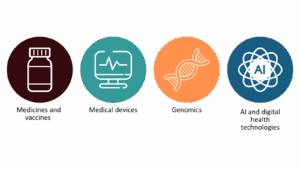
Over time, the scope of our specialty has expanded dramatically. What began with a focus on medicines and vaccines now also encompasses: medical devices, diagnostics, genomics, and AI and digital health technologies.
Despite this broadening scope, the same fundamentals apply: new technologies must be shown to work, their safety profile must be understood, they must be manufactured to consistent quality, and they must be introduced ethically and responsibly into clinical practice, with ongoing monitoring.
Keeping Patients Safety at the Core
Our specialty is very much focused on patient safety and ensuring that innovation improves lives without compromising quality. As the pace of change accelerates, pharmaceutical physicians work to balance two priorities: enabling medicines and other technologies to reach patients as quickly as possible, whilst ensuring quality and safety.
But science does not stand still, and neither do societal expectations. Today, our specialty is also shaped by:
- Health inequalities – ensuring diverse populations are included in development plans and preventing new technologies from widening gaps in care.
- Transparency – from clinical trial reporting to the way industry collaborates with clinicians.
- Sustainability – embedding planetary health and environmental responsibility into our practice.
These evolving expectations highlight the importance of ethical, responsible approaches in everything we do.
Looking Ahead: FPM’s New Strategy
FPM is evolving to meet these changes. Our role is to ensure that the standards, education, training and policy work we support is relevant and meaningful for our members and stakeholders. We are committed to being focused on leading the specialty and supporting pharmaceutical physicians worldwide to practise at the highest ethical and professional standards.
With this in mind, our new strategy, which comes into effect on 1 January 2026, will be built on four pillars:
- Promoting a shared professional identity
- Increasing reach and influence
- Nurturing ideation and innovation
- Embedding good governance to underpin resilience
The strategy will be about more than adapting to change, it will ensure that FPM remains at the forefront of pharmaceutical medicine, guiding our members to deliver innovation responsibly and for the benefit of patients.