
Specialty Training: Advice from Our Regional Specialty Advisers
Posted on: Monday 27 July 2026
Regional Specialty Advisers (RSAs) are experienced pharmaceutical physicians who work together with us and the GMC to support the delivery of high-quality Pharmaceutical Medicine Specialty Training (PMST) across the UK. Each RSAs acts as the main point of contact for trainees, educational supervisors and training sites within their region, offering impartial advice on the PMST curriculum, assessments, progression and training quality.
They also support prospective and existing training sites, contribute to Annual Review of Competence Progression panels, and help identify and address regional issues affecting trainees. Through this work, RSAs play an important role in maintaining training standards and helping pharmaceutical physicians progress towards a Certificate of Completion of Training in pharmaceutical medicine.
Find out from our current RSAs what makes the specialty exciting, what advice they would give to doctors considering PMST and what successful progress looks like.
Current RSA as of July 2026:
Dr David Williams FFPM

Dr Alan Lenox-Smith FFPM

Dr Stephanie Jones FFPM
Dr Zahid Bashir FFPM
Dr Usman Farooqui FFPM is also an RSA.
What makes pharmaceutical medicine an exciting specialty to train in?
The breadth of opportunity and the sheer variety of companies, roles and an opportunity to work all over the globe.
– David Williams
Working in pharmaceutical medicine means one is always at the forefront of innovation which is always an exciting place to me. I work in oncology and the advances made using precision medicine has revolutionised the treatment of some cancers such as lung cancer where the prognosis used to be terrible. It is a privilege to be part of this journey and see how the new drugs can improve the life of patients.
– Alan Lenox-Smith
We work at the cutting edge of medical science, protecting patients and bringing them new medicines. There are so many sub-specialties in pharmaceutical medicine it is possible for everyone to find their niche.
– Stephanie Jones
For me, the excitement is scale of impact. In clinical practice you help one patient at a time; in pharmaceutical medicine, a well-designed trial or a sound benefit-risk judgement can change the standard of care for thousands. I’ve felt that most acutely working on cell and gene therapies and immuno-oncology, where a first-in-human decision directly shapes whether a new mechanism reaches patients at all.
It is also intellectually restless in the best way. You sit at the intersection of medicine, statistics, regulation, ethics and commercial strategy, and no two problems are identical. One week you’re chairing a dose-escalation review; the next you’re defending a design to a regulator. That breadth, combined with the pace of scientific innovation in oncology, means you’re rarely doing the same thing twice and rarely bored.
– Zahid Bashir
What advice would you give to doctors considering Pharmaceutical Medicine Specialty Training?
Consider it seriously and explore what it will entail, essentially your commitment at a busy time in your life. The grounding and expertise you will gain will give you a huge confidence boost, and a tremendously strong set of skills. It will also give you the opportunity to network with colleagues and senior medical leaders which will be invaluable.
– David Williams
Get a good grounding in medicine first, preferably obtaining a post graduate qualification such as MRCP or MRCGP. The industry is after your medical knowledge. Speak to others in pharmaceutical medicine before applying so that you are fully informed before changing career.
– Alan Lenox-Smith
Make sure you have completed all the necessary clinical training first. Engage with FPM and seek advice early, they are really friendly and will do whatever they can to help. Don’t consider this an “easy option” – make sure you have the time to commit to this training.
– Stephanie Jones
Talk to people doing the job before you commit, the day-to-day is less like clinical medicine than most doctors expect, and you want to be sure the trade-offs suit you. You give up direct patient contact, but you gain influence over how medicines are developed and used.
Build your evidence and statistics foundation early. Much of your credibility will rest on how rigorously you interrogate data, so treat biostatistics and trial methodology as core clinical skills, not administrative ones.
Finally, stay close to the science. The specialties that will shape the next decade will reward pharmaceutical physicians who understand mechanism deeply, not just process. And keep your clinical instincts sharp; when you’re weighing a safety signal, the fact that you’ve sat at a bedside still matters enormously.
– Zahid Bashir
What would you say to someone who is unsure whether Pharmaceutical Medicine is the right specialty for them?
Ask around! Find someone or several people you trust and get their opinion. In the end the most important decision is ‘what do I want in my life?’ It may be the speciality is not right for you, or it may be a difficult time right now. You can always revisit your decision later in your career.
– David Williams
Take your time and speak with others. There are several different entry points into industry such as research, medical affairs and Drug Safety. There are big differences working for a small biotech and a large pharma company. Find what is best for you.
– Alan Lenox-Smith
Speak with people who work in this industry. Ask them about their role and what they know of other medical roles. There are so many different areas it is possible to find something that fits anyone, but if you only see one job you may miss this. Read “Discovering new medicines”. Check out the PMST curriculum and other information on the FPM website.
– Stephanie Jones
Uncertainty is reasonable — this is a fundamentally different way of practising medicine, and it isn’t right for everyone. The honest test is what energises you. If you’re drawn to the individual therapeutic relationship and the immediacy of clinical care, you may find development work too far removed and too slow.
But if you find yourself more curious about why a treatment works, how the evidence was generated, and whether it truly benefits populations, that instinct matters. Those are the questions this specialty lives on.
You also don’t have to decide in the abstract. Spend time with a medical monitoring or clinical development team, sit in on a data review, and see whether the problems grip you. And remember the clinical years are never wasted — the best pharmaceutical physicians I know are the ones who never stopped thinking like doctors.
– Zahid Bashir
What do you see as the key strengths of PMST, and what aspects do you feel are most valuable to trainees?
The structure and objectivity within the programme is a real strength, so having clarity of what is expected is hugely valuable. Ultimately the achievement of knowing you are at a level of trust in your competency will give you a big confidence boost.
– David Williams
PMST gives an excellent grounding in pharmaceutical medicine and by learning and revising for the Diploma in Pharmaceutical Medicine (DPM) one learns about the breadth of pharmaceutical medicine. This can help set up a pharmaceutical physician to take a path they may not have realised existed without the training. It is certainly worthwhile doing.
– Alan Lenox-Smith
This training gives medics a fantastic opportunity to connect with people working in other areas of this industry and it provides an “excuse” to get involved in work that is outside the routine.
It facilitates a great level of understanding of how other disciplines work, and how the Trainee’s specific role fits into the bigger picture, which improves their work and benefits the organisations they work for.
PMST is particularly valuable for new entrants to industry, and for experienced medics joining a new company, as it allows them to approach other members of the team (e.g. to ask for support to complete workplace-based assessments), which improves working relationships and smooths communication channels.
When PMST is properly embraced it can result in projects that form the springboard for promotion and can result in measurable improvements for patients.
– Stephanie Jones
PMST’s real strength is that it is a structured, examined route to competencies that people otherwise pick up haphazardly on the job. The curriculum forces breadth — clinical pharmacology, statistics, regulation, drug safety, ethics, healthcare economics — so you finish with a coherent framework rather than fragments.
For trainees, I think the most valuable elements are the discipline of the Diploma examinations and the emphasis on workplace-based assessment against real projects. Being made to demonstrate competence on live development work, judged by experienced supervisors, builds judgement far faster than reading alone.
The other quiet strength is the professional identity it creates. Pharmaceutical medicine can feel isolating for a doctor who has left the ward, and a recognised specialty with a faculty behind it gives you standards to be held to, peers to learn from, and a sense that this is medicine.
– Zahid Bashir
What does good progress or success look like to you in this specialty?
Job satisfaction and achieving success in your projects and with your colleagues, being the person that people want on their teams and down the line will stay in touch. Promotions will follow, opportunities to explore and be sponsored as company talent will follow.
– David Williams
This will be a very individual assessment. One does not need to become a medical director to succeed, there are other paths such as depth of experience, international, research and all of these can lead to success in one’s field. And obviously I shouldn’t forget that to be recognised by the FPM by becoming a Fellow is also gratifying and a sign of success.
– Alan Lenox-Smith
From my perspective as an Education Supervisor it is important that the Trainee demonstrates capabilities in the specialty they are working in, and develops capabilities for other specialities so that they fully understand the areas with which they may interact in their current role. Reflection is a key element in making progress, leading ultimately to successful completion of PMST and achieving CCT.
From my perspective as an ARCP Panel reviewer I need to see the right forms in the portfolio, completed in the right way, so that I can easily assess the Trainee and check everything is in place. Passing the DPM exam is a crucial step and many people leave this too late so I would advise preparing for this as soon as they start training, and take the exam as early as they can.
– Stephanie Jones
Early on, success is competence you can defend: reading a protocol and seeing its flaws, interpreting a safety dataset without being led, holding your own in a discussion with statisticians and regulators. It’s the point where senior colleagues stop checking your reasoning.
Later, it becomes judgement under uncertainty. The hardest decisions in drug development — whether to escalate a dose, pause a study, or continue after an ambiguous signal — rarely have clean answers. Progress is being trusted to make those calls and being right often enough that patients are protected and good medicines aren’t abandoned prematurely.
Ultimately, though, I measure success by outcomes I can point to: a therapy that reached patients because the development was done well, and, just as importantly, a programme I helped stop because the data didn’t support going on.
– Zahid Bashir
Pharmaceutical Medicine Specialty Training (PMST) is a four-year programme offered exclusively by FPM, leading to the award of a Certificate of Completion of Training (CCT) in pharmaceutical medicine, following which a recommendation is made to the General Medical Council (GMC) that the trainee is eligible to apply for entry onto the Specialist Register.
The programme provides structured training in the scientific, clinical, regulatory, and ethical aspects of pharmaceutical medicine, equipping doctors with the knowledge, professional skills, and leadership competencies required for safe and effective specialist practice in line with GMC standards. Trainees maintain an e-portfolio and complete workplace-based assessments throughout the programme, with successful completion formally recognised at the FPM Annual Awards Ceremony.
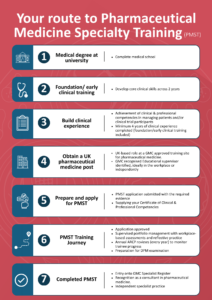 Read our simple steps on how you can get into Pharmaceutical Medicine Specialty Training.