Reflections on the Annual Conference 2026
Posted on: Wednesday 25 November 2026
Firstly, what an engaging day. I really felt a positive buzz in the air. I hope those of you who joined both in person and online felt that too. The day was made by the contributions of those attending, by way of engaging with the speakers, engaging in the workshops, and engaging with each other in the breaks. So, thanks to you for attending.
And, before I get into the content of the day, thank you to the speakers who all kindly volunteered their time to prepare their sessions and deliver them.
Anyway, onto the day itself. We had a very broad conference programme this year under the umbrella title and theme of looking into the future. Whilst the sessions ranged from debating the pharma model through to a workshop on building your own brand, they all were about preparing you for the future. The aim, and I think we can say we delivered on the aim, was to put on a conference that was both interesting and had practical takeaways for delegates. It is a hard balance to get right, but one we will look to strike again next year.
The whole day was chaired by Dr Kirsty Wydenbach FFPM, who, in addition to managing the online questions and introducing speakers, managed to keep us all to time (easier said than done). Kirsty also put a huge amount of effort into the programme and really helped make the day a success.
Our President, Dr Sheuli Porkess PFPM, opened the Conference with her President’s Address. She provided some clear scene setting about the direction FPM has been heading and plans for the future. FPM has undergone a real review of its own membership with its Membership Project and we have raised our external voice in terms of delivering relevant policy influencing pieces, such as our work on tackling health misinformation. Sheuli also outlined some new initiatives for the year ahead, from delivering a State of Pharmaceutical Medicine report (providing a comprehensive overview of the current state of pharmaceutical medicine across the UK) to the ethical thought leadership piece beginning in 2027. Ethical questions underpin the work that all physicians and colleagues in pharmaceutical medicine must think about, so it is critical that there is a foundation for decision-making where established rules and frameworks are insufficient. Sheuli announced that FPM will deliver a proactive thought leadership piece which addresses the key ethical questions relevant to pharmaceutical medicine and physicians of the future.
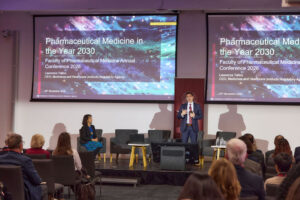
Lawrence Tallon, CEO of the MHRA, delivered the opening keynote. Lawrence is a fantastic and engaging speaker. I think we can all confidently say what he (and his leadership team) has done at the MHRA is phenomenal. It’s a forward-thinking regulator which embraces innovation. You could see that reflected in his keynote, he gave an overview of where he sees pharmaceutical medicine over the next five years, from that explosion of AI to the development of medicines in space. And look, there is a lot of worry out there, in terms of global threats to UK supply chains, to that uncertainty about AI. But, and this is important, he ended on an inspiring note, going back to the patient story and showing real-life patients who have benefited from recent innovative medicine developments. We can all fall foul of missing out on that patient-centric approach, but Lawrence certainly didn’t.
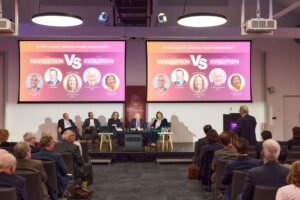
Onto our inaugural debate (chaired by Dr Emma Harvey FFPM) debating the question ‘is the current pharma model sustainable?’. Attendees voted before the debate started and after it finished. Before the debate started the vote results showed that 80% of the audience believed the pharma model needed to change. After the debate, just 55%. Meaning that the debate team arguing for a gentle evolution of the pharma model put forward some persuasive arguments. The debate covered topics such as the rise of AI, evolving regulations, economic pressures, and changing approaches to drug development and manufacturing. Well done to the debate teams of Professor Alan Boyd FFPM and Dr Renata Crome MFPM(Hon), and Ian Nicholson and Dr Jeymi Tambiah FFPM.
Next came our interactive workshops. This is where we really dived into developing those practical skills. The workshops covered managing AI in pharma (led by Dr Michael Zaiac FFPM and Julius Neiser), building your personal impact (led by Dr Harjeet Dhillon FFPM, Andy Collier, and Dr Fiona Thomas), and communicating to influence (led by Dr Lisa Moore-Ramdin FFPM, Rachel Schofiled, and Edward Wareing). There were white boards, sticky notes, and for the impact workshop, roaring like a lion (vocal warmups, so it was relevant). Attendees could only attend two. I joined the building your personal impact and the communicating to influence workshops, which were both fantastic, engaging, and as noted above, had real world takeaways. Let me give you a takeaway from the influencing workshop, the magic influencing formula is: effective influence is credibility x trust x clarity x timing. You’re welcome.
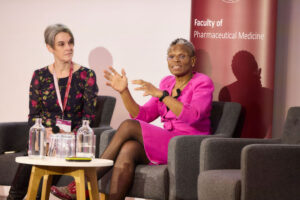
The afternoon plenary explored bringing children’s perspectives and guardian voices into clinical research. The panel was chaired by Dr Lisa Moore-Ramdin FFPM, and consisted of two experts, Bryan Bennett and Emma Sparrow. Children are not just ‘small adults’. Sorry, I appreciate that is obvious, but it frames the importance of building their unique physiology and experiences into the clinical trial design. The interesting discussion covered the importance of engaging young people and, where relevant (it almost always is), their parents and guardians. Meaningful patient involvement is about more than simply asking for feedback. It’s about understanding the experiences, needs and priorities of children and their guardians, and using those insights to shape how clinical studies are designed and delivered. Bringing in the patient perspective and experience, as I said at the beginning, is vital. And meaningfully addressing the needs of children themselves requires special and needed attention.
Finally, the closing keynote came from Professor Dame Ijeoma Uchegbu, DBE, FMEDSci. This was a fantastic and inspiring way to wrap up the day. With a career spanning pioneering research in drug delivery and pharmaceutical innovation, she explored the future trends that could transform the way medicines are developed and delivered. Her keynote began with a fascinating exploration of molecular changes and the drug development pathway, drawing on her expertise in nanoscience. She also highlighted the importance of publicly communicating scientific research to the wider public. This keynote certainly had a more ‘scientific’ approach to it, which I could see delegates were really engaged with. Our thanks to her.
And well done to Yolanda Garcia for winning the FPM scavenger hunt that was on throughout the day. She won an M&S food hamper!
So, onto next year: the Conference will be on Tuesday 9 November, taking place at Royal College of Physicians, 11 St Andrews Place, London, NW1 4LE or online. Hopefully I’ll see most of you before then, but if not, see you there.