
Pharmaceutical medicine at the crossroads
Posted on: Thursday 26 November 2026
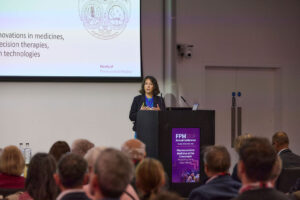
At FPM’s 2026 Annual Conference, I asked what the pace of change in pharmaceutical medicine means for our specialty and for the patients we serve. Science and technology are advancing, public expectations are changing, and geopolitical, economic and environmental pressures are shaping how medicines and other health technologies are developed and used. Helping our specialty navigate and shape these changes has been central to FPM’s current strategy.
What holds our specialty together?
Pharmaceutical medicine is a recognised medical specialty concerned with developing, regulating and supporting the clinical use of medicines and other health technologies. Its development was shaped by the thalidomide tragedy, which underlined the need for doctors working on medicines to have specialist training and clear professional standards. Today, our work spans medicines, vaccines, medical devices, diagnostics, precision therapies, artificial intelligence (AI), genomics and digital health.
Across these areas, we ask the same core questions: Does it work? Is the risk acceptable in the context in which it will be used? Can it be delivered to a consistent standard? Is it being used ethically?
FPM is a Faculty of the UK’s three Royal Colleges of Physicians and a registered charity. Our mission is to advance the science and practice of pharmaceutical medicine by developing and maintaining competence, ethics, integrity and the highest professional standards for the benefit of the public.
What does the crossroads look like?
I created the accompanying illustration with Perplexity to create a visual stimulus to explore the question of what FPM’s charitable purpose means at this point in time. The image brings together medicines, science and technology, with people of different ages and needs woven throughout. The paths crossing in the foreground represent the choices we face as scientific possibilities, patients’ medical needs and society’s ethical expectations evolve around the world.
Several of those choices came through in FPM’s 2025 survey on the future of the specialty and in my own observations. AI, for example, could potentially offer significant benefits, such as in tackling antimicrobial resistance but its use also raises questions about what evidence we need before relying on an AI tool and who is accountable for decisions informed by it. As health systems place greater emphasis on prevention and respond to ageing populations, we need to consider how we reflect those needs in the work we do as pharmaceutical physicians. This is related to the question of health equity. The need for recruiting representative populations into trials to ensure representative trial populations is understood as good science, but we also need to ask about whether the innovations we work on support health equity in practice or whether they inadvertently widen inequalities. We also need to be transparent about the evidence and its limitations, and adjust our communication to be relevant and accessible in an era or mis- and dis-information.
The global context is changing too. A recent visit to China gave me a chance to see the scale of innovation there and to learn more about approaches to medicines access. The ongoing development of the African Medicines Agency is another example of how the international landscape is evolving. Closer to home, a very hot summer prompted me to ask how we can develop health technologies that are relevant and usable as the climate changes. Directly affecting many members are financing pressures in early-stage life sciences and rising living costs meaning there is uncertainty within the profession too about roles.
These are practical questions for our specialty. The conference gave us space to consider them together and to ask where FPM can make a useful contribution

What FPM did in 2026
Our work this year focused on two priorities: developing FPM as a professional home and helping the sector navigate uncertainty. FPM Connect supported mentoring and networking. The Summer Gathering and the President’s Lecture with Hannah Cockcroft CBE (as the guest speaker) brought colleagues together, while the FPM Annual Awards recognised professional achievement. Through the Membership Project, we heard from members about what they need from FPM. Thank you to everyone who contributed to the Voices of Pharmaceutical Medicine survey or took part in a focus group.
We published our first annual horizon-scanning report in July to identify emerging trends, risks and opportunities. We worked with the Faculty of Public Health on health misinformation and disinformation, and are working with the Association of the British Pharmaceutical Industry (ABPI) and the Patient Information Forum on a separate misinformation paper. With input from our expert groups, we submitted 10 responses to external consultations, our highest annual total to date. We also established the Climate Change and Sustainability Forum and strengthened relationships across health and life sciences, including with the Association of British HealthTech Industries and the Academy of Medical Royal Colleges.
What comes next in 2027?
The Membership Project will move from listening to delivery, using what members told us to guide the support and opportunities we provide. We will also produce a State of Pharmaceutical Medicine in the UK report. It will examine the specialty across all four UK nations and set out key actions for decision-makers.
At the conference I also announced a new ethics thought leadership project. It will examine what ethical questions pharmaceutical physicians should consider, when making decisions, today and in the years ahead as technology and societal expectations change. The 2025 FPM survey identified a need for support with ethical practice. We want to understand where colleagues face difficult decisions, and what would help them exercise professional judgement in their daily work. The intention is that the findings to inform the development of practical resources. I encourage colleagues, in whatever setting you practice – in commercial, academic, regulatory and clinical – to take part when we invite contributions. The decisions you encounter in your own work will help us identify where support is most needed.
Thank you to everyone who joined us at the conference and to our partners: ABPI, Advance AI and AITHENA (Gold partners); Pharma Partners and Pharmora (Silver partners); and My Medical Department (Bronze partner). Thank you also to our featured charity, Doctors in Distress, for its work to protect the mental health of healthcare workers and for working with FPM to support our members.