
Are you ready for the UK’s new Clinical Trials legislation?
Posted on: Friday 10 April 2026
Do you have 28th April 2026 marked in your calendar? The date marks a significant milestone for clinical research in the UK, with the implementation of updated clinical trial legislation designed to modernise and streamline how studies are approved and conducted. These changes aim to enhance patient safety, improve transparency, and make the UK a more attractive environment for high-quality research. As the new framework comes into force, it’s an important moment for those working in pharmaceutical medicine to reflect on what’s changing, why it matters, and how it will shape the future of clinical trials.
Since we first heard about the potential changes, the clinical trial legislation has gone through public consultation, government debate, legal drafting, new guidance, and is now embedded in our work practices for all UK clinical trials.
Now is a good time to appraise yourself of the key changes, and in case you missed the FPM workshop on this in October, we have outlined some of them below.
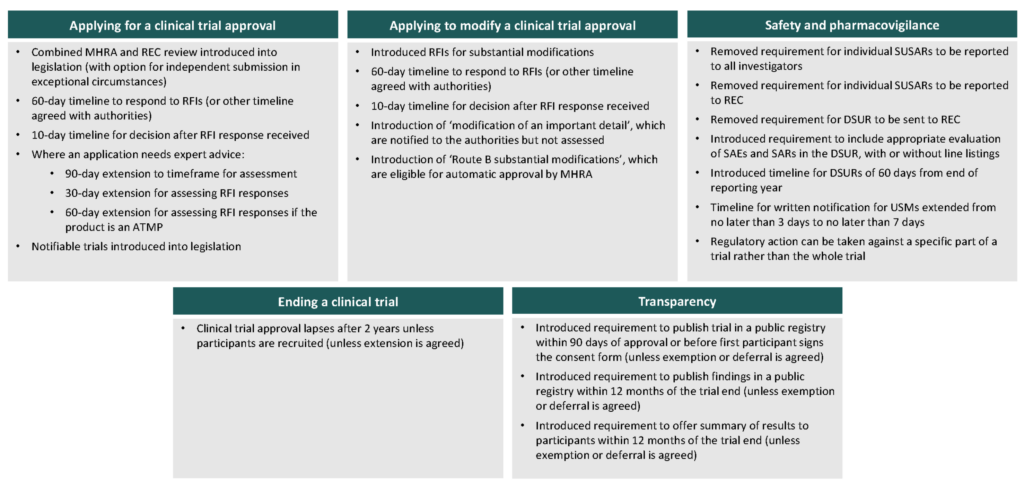
Five of the most impactful changes
- Combined Review is now enshrined in law: A single approval route brings together Medicines and Healthcare products Regulatory Agency (MHRA) and Research Ethics Committee (REC) review. Sponsors submit one application via IRAS, with parallel assessment, coordinated requests for further information, and a single, unified decision.
- Risk-proportionate regulation is formally defined: The legislation introduces a clearer, risk-based framework, including a new category of “notifiable trials” for lower-risk Clinical Trials of Investigational Medicinal Products (CTIMP). These studies can follow a notification pathway rather than full authorisation, reducing unnecessary burden.
- Amendments become “modifications” with streamlined pathways: Aligning with EU terminology, amendments are now termed “modifications” and grouped into new categories—substantial (Route A and Route B), important, and minor. Sponsors classify modifications, supported by MHRA guidance, with Route B offering accelerated timelines and no RFI stage.
- Stronger transparency requirements: There is now a legal requirement for trial registration in a WHO-recognised public registry, alongside defined timelines for publishing summary results and enhanced expectations for public disclosure.
- Integration of ICH GCP E6 (R3): The updated framework embeds E6 (R3) principles, placing greater emphasis on data integrity, identification of critical quality factors, and risk-based quality management across the trial lifecycle.
There are clear transitional arrangements in the guidance, noting that there is no transition ‘period’. The rules apply immediately to all submissions, including substantial modifications submitted from 28th April 2026. Any applications already submitted but that remain under review or awaiting a final response remain under the ‘old’ rules, but only until the approval is in place.
Aim of the legislation
The updated legislation also strengthens the UK’s position as a globally competitive destination for clinical trials, particularly when compared with countries such as Australia, which has traditionally been favoured for its streamlined regulatory pathways and rapid start-up timelines. By introducing more proportionate regulation, faster approvals, and a more flexible, risk-based approach, the UK aims to reduce unnecessary administrative burden while maintaining robust standards for participant safety. In doing so, it seeks to combine scientific and clinical excellence with a regulatory environment that is both efficient and internationally attractive – helping to ensure the UK remains at the forefront of innovative research.
Sponsors will be closely monitoring the impact of these changes on their internal processes, timelines, and resource allocation. FPM will also be keeping a close eye on how the MHRA implements and manages these updates in practice. While these changes, if realised, will be welcomed, decisions about the UK as a destination for clinical trials will also be affected by speed and completion of trials delivery in our globally competitive environment. Recent reports show the number of patients in industry sponsored trials has fallen over recent years and risks being a vicious circle given the low and falling levels of pharmaceutical investment in the UK. The benefits of conducting trials are well proven from both a scientific and economic perspective. There are positive moves however, by both UK Government and industry to address patient identification for clinical trials and uptake in later phases with greater MHRA/HTA collaboration. Ultimately, the new reforms will be judged by whether they deliver faster study set-up, fewer avoidable delays, and better trial recruitment and delivery in the UK.
These regulatory and recruitment facilitation actions cannot be viewed in isolation however. As welcome as they are, the attraction of the UK as a destination for studies will only improve if speed of set up and recruitment, together with delivery against targets, actually happens. Any drift in timelines, or failure to address other barriers, would be a backward step, and particular attention will be paid to the proportion of substantial modifications that generate RFIs, especially given the current position where the majority are approved without issue. The future proposal for a 14 day assessment for phase 1 trials is also a welcome development, marking a return to previous standards and reinforcing the UK’s attractiveness as a destination for early-phase research, particularly for Phase 1 CROs.
Watch this space, the coming months will be critical in determining whether these changes deliver meaningful improvements in efficiency and maintain the UK’s competitive edge.
Missed our online workshop on the new legislation? Watch it On Demand – available to purchase for a limited-time only!
You can purchase access to the content here. If you’re an FPM member, please ensure you are logged in to My FPM to benefit from our member rates.